
With the rapid growth of road transport demand, overloaded vehicles pose significant risks to roads, bridges, tunnels, and overall traffic safety. Traditional overload control methods, due to fragmented information, low efficiency, and slow response, are increasingly unable to meet modern regulatory requirements. In response, our company has developed the Smart Overload Control Management Information System, leveraging information technology, networking, and intelligent technologies to achieve centralized data collection, dynamic management, real-time comparison, intelligent analysis, and automated processing. This system provides traffic management authorities with efficient and accurate tools for controlling overload, ensuring road safety and infrastructure durability.
Our system is designed at the national-level framework, constructing a comprehensive, full-time, full-chain, and full-region overload control and supervision structure. It enables interconnection and data sharing among source stations, fixed roads, mobile road enforcement, and the national central control center, forming a full-process regulatory model from source loading to road operation and enforcement. Through technological monitoring, data collaboration, and closed-loop enforcement, the system effectively controls overload at the source, ensures roads remain within service life, promotes regulated vehicle operations and fair tolls, and safeguards transport infrastructure and national interests.
The overall system is composed of four major functional modules: the Source Station Overload Control System, the Fixed Road Overload Control System (highways + national, provincial, municipal, and county roads), the Mobile Road Overload Control System, and the Toll Management System. These modules work in coordination to create a comprehensive supervisory system covering the entire road network and all scenarios.
Part One: Source Station Overload Control System
The primary goal of the Source Station Overload Control System is to reduce or eliminate overloaded vehicles leaving origin stations. Key targets include vehicles from mines, ports, airports, logistics parks, factories, and transport companies. Continuous, 24/7 monitoring ensures vehicles comply with loading regulations at the source.
1. Eight-Platform Dynamic Vehicle Weighing System
At the exits of monitored sites, the Eight-Platform Dynamic Vehicle Weighing System is deployed to strictly detect vehicle overloads before they enter public roads. This system consists of:
Eight-Platform Electronic Vehicle Scale – Utilizes high-precision load cells, axle count and distance recognition, vehicle dimension measurement, and optical raster separation to dynamically detect vehicle weight and size.
Unmanned Weighing Management System – Comprises industrial PCs, weighing management software, surveillance cameras, LED display screens, voice prompts, intelligent control cabinets, and networking systems to automatically identify vehicles, collect data, determine overload status, and manage release.
Operational Workflow: Vehicles enter the weighing area after loading. The system automatically measures weight and dimensions and compares them with approved load limits. Compliant vehicles are automatically released, while overloaded vehicles are required to unload until they meet standards. The system integrates with regional government platforms to enable data sharing and remote supervision, ensuring real-time visibility of source overload control.
2. Onboard Vehicle Weighing System
To further achieve dynamic supervision, vehicles are equipped with the Onboard Vehicle Weighing System, capable of real-time monitoring of static and dynamic vehicle loads. The system includes onboard weighing software, smart instrument displays, and weighing units (laser distance or strain-gauge type), allowing drivers to view current load and receive warnings during loading. Overloaded vehicles are prompted to unload, with data simultaneously uploaded to fleet management platforms and government systems, and, if necessary, automatically generating overload notices or fines.
The system uses suspension load cells to monitor deformation of leaf springs, axles, or air suspensions and applies a closed-loop “sense–calibrate–calculate–apply” methodology to build load models. Software algorithms compensate for environmental factors, ensuring measurement accuracy. Static weighing precision reaches ±0.1%~±0.5%, while indirect weighing precision achieves ±3%~±5% under ideal conditions, suitable for operational management and risk alerts.
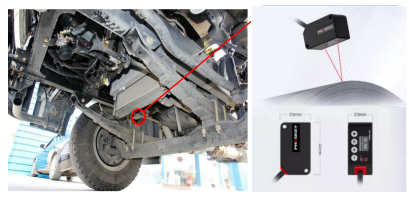
Suspension-Mounted Frame Deformation Laser Distance Measurement System
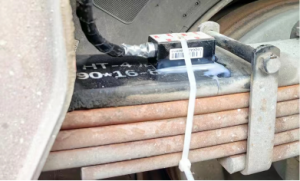
Suspension-Mounted Frame Deformation Load Cell
By combining the Eight-Platform Dynamic Vehicle Weighing System with the Onboard Vehicle Weighing System, vehicles can self-check, fleets can self-inspect, and authorities can supervise the entire process, creating a fully integrated, real-time source overload control management model that ensures traffic safety and long-term infrastructure stability.
Post time: Dec-09-2025